


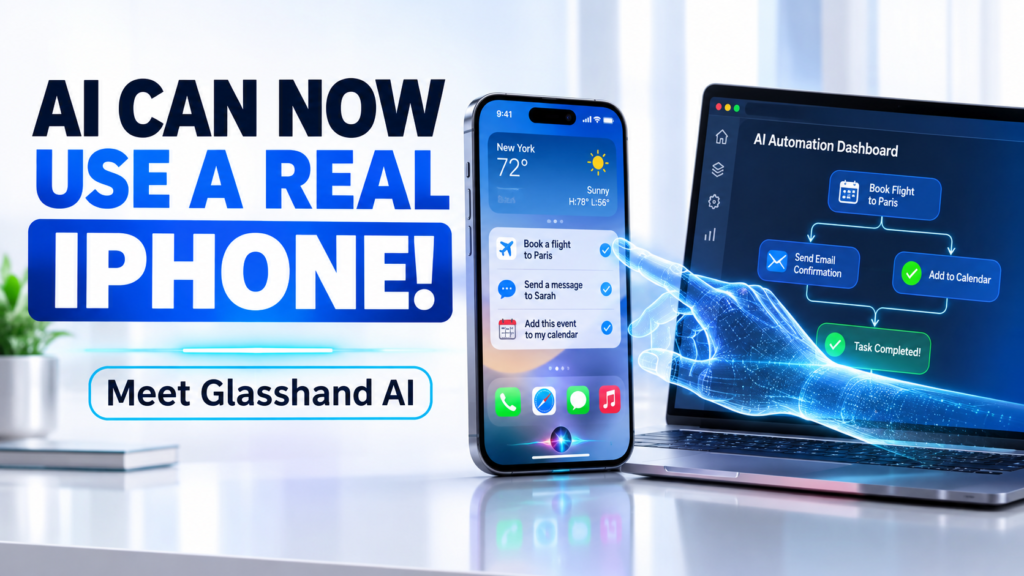
Imagine telling your AI assistant, “Open Instagram, upload my latest video, reply to comments, and send a message to a potential customer.” Instead of giving you instructions, the AI actually opens an app, taps the screen, types messages, and completes the work. Sounds like science fiction? Not anymore!
Glasshand AI is a newly launched technology that gives artificial intelligence (AI) agents access to real iPhones and Mac computers. Instead of simply answering questions or generating content, an AI agent can now interact with physical Apple devices and perform tasks much as a human does.
Launched publicly on November 5, 2026, Glasshand is attracting attention because it addresses one of the biggest limitations of modern AI agents: they can think, write, and plan, but they still struggle when a task requires interacting with a real mobile application or computer.
Let’s understand what Glasshand is, how it works, what makes it different, and how this technology could help ordinary people, business owners, developers, and content creators.
What Is Glasshand AI?
Glasshand is a technology platform that connects AI agents to real physical iPhones and Mac computers hosted in a data center.
In simple words, it gives an AI assistant its own phone and computer to work with.
Normally, when you ask ChatGPT or another AI tool to perform a task, it may explain the steps or create the information you need. However, it cannot automatically complete every task inside your mobile applications.
For example, an AI can write an Instagram caption, but posting that caption through the Instagram mobile application requires interacting with the actual app.
This is where Glasshand comes in.
It provides a dedicated physical device that an AI agent can control through a special connection called an API (Application Programming Interface).
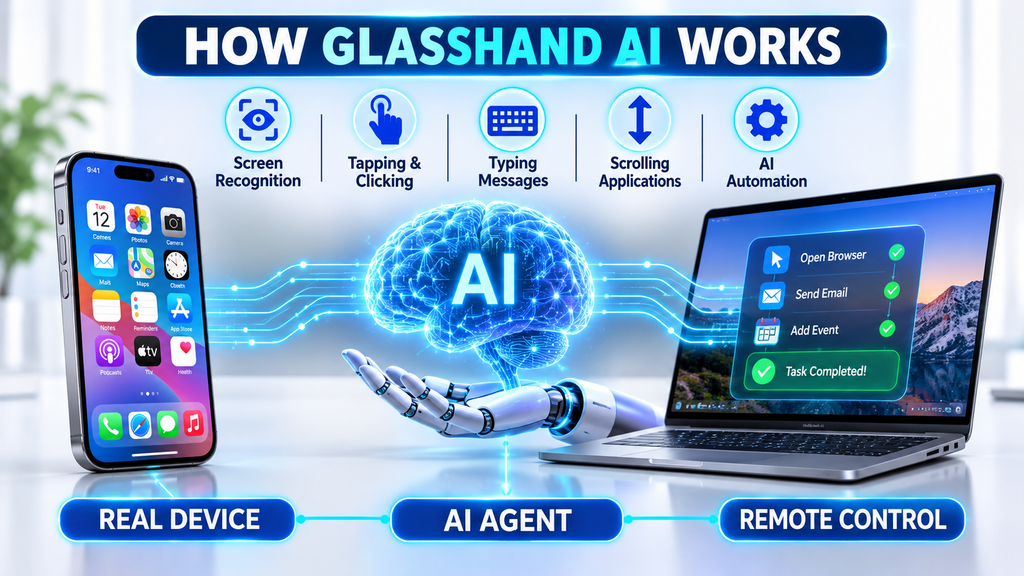
The AI agent can:
- See what is displayed on the screen.
- Tap buttons and open applications.
- Type messages and other information.
- Scroll through pages.
- Interact with installed applications.
- Perform supported tasks on a real iPhone or Mac.
The important difference is that Glasshand does not simply provide a virtual phone or computer. It provides access to actual physical Apple hardware.
Why Is Glasshand AI Getting Attention?
To understand why Glasshand matters, we first need to understand a problem with existing AI assistants.
AI technology has improved significantly. Modern AI agents can research information, write code, create documents, analyse data, and operate websites.
However, many tasks still require human involvement.
Think about these everyday activities:
- Opening WhatsApp and replying to a message.
- Posting a video on Instagram.
- Booking a cab using Uber.
- Downloading and testing a mobile application.
- Receiving a verification code through SMS.
These activities require an AI agent to interact with an application running on a real device.
Traditional browser-based automation cannot handle every mobile application or device-specific function.
Glasshand aims to bridge this gap by giving AI agents access to real Apple devices.
Its purpose is simple: allow AI agents to move beyond providing answers and start completing more real-world tasks.
How Does Glasshand AI Work?
You do not need to be a software engineer to understand the basic working process.
Think of Glasshand as renting a smartphone or computer remotely and allowing an AI assistant to operate it.
Here is how the process works.

Step 1 – Rent a Real iPhone or Mac
First, you choose the device you want from the Glasshand platform.
You do not need to purchase an expensive iPhone or Mac yourself. Glasshand hosts and maintains the hardware in its data center.
You rent the device on a monthly subscription.
Step 2 – Connect Your AI Agent
Glasshand supports AI agents such as:
- Claude Code
- OpenAI Codex
- Cursor
- OpenClaw
- Hermes
It also supports other agents that can connect through its API.
This is important because you are not forced to use only one AI assistant.
You can connect an agent that already fits your working style.
H2: Step 3 – Give Your AI Instructions
Once the connection is established, you can give your AI agent instructions in normal language.
For example:
“Open Instagram, upload this video, add the caption, and publish it.”
The agent then uses the connected iPhone to interact with Instagram.
Step 4 – AI Controls the Device
This is the most interesting part.
Glasshand uses a dedicated controller that allows the AI agent to see the device screen and send actions.
It can tap, type, click, and scroll.
Imagine a person sitting in front of a computer and using a mouse and keyboard. Glasshand allows an AI agent to perform similar actions remotely.
Step 5 – Your Device Remains Dedicated to You
Glasshand says that each rented device is assigned to one customer rather than shared with other customers.
Your installed applications, settings, files, and sign-ins can remain available while your rental is active.
When you release the device, Glasshand says it erases the data and restores the device to factory settings.
This makes it possible to maintain a working environment instead of setting everything up again for every task.
7 Powerful Ways Glasshand AI Can Help People
The real value of Glasshand is not just its technology. It is what people can potentially do with it.
Let’s look at seven practical applications.
1. Social Media Management Without Constant Manual Work
Social media management takes a lot of time.
Content creators and small business owners regularly need to upload videos, write captions, respond to comments, and communicate with potential customers.
Glasshand could help AI agents perform supported tasks inside applications such as Instagram, TikTok, and LinkedIn.
For example, imagine running a small YouTube or Instagram content business.
You could instruct your AI agent to:
- Open the relevant social media application.
- Upload a prepared video.
- Add a suitable caption.
- Publish the content.
- Check comments.
- Draft replies to followers.
This could reduce repetitive manual work and give creators more time to focus on making better content.
However, users should still review posts and messages before allowing an agent to publish or send them automatically.
2. Helping Small Business Owners
Small business owners often manage several responsibilities themselves.
They handle customers, marketing, enquiries, follow-ups, and daily administration.
Hiring people to manage every activity may not be affordable for a new business.
With Glasshand, an AI agent could potentially help with supported tasks such as checking business messages, responding to routine enquiries, and following up with customers through installed applications.
For example, a local clothing business could use an AI agent to prepare customer responses and manage social media activities.
This does not mean a business can operate entirely without employees. It means certain repetitive activities could become easier to automate.
3. Helping Mobile App Developers
This is one of the most interesting applications of Glasshand.
Developing a mobile application is not just about writing code. Developers also need to test whether the application works correctly on actual devices.
For example, imagine someone developing a shopping application.
They need to check:
- Whether users can register successfully.
- Whether login works properly.
- Whether product pages open correctly.
- Whether checkout works.
- Whether the application behaves correctly on an iPhone.
Glasshand allows an AI agent to use a hosted Mac for development with Xcode and test applications on a real iPhone.
This could be useful for independent developers and small software development teams that do not want to maintain additional Apple hardware.
4. Automating Everyday Administrative Tasks
Many people spend hours handling small digital activities.
These activities may include checking messages, organising information, managing calendars, and following up on pending work.
Glasshand gives AI agents access to applications and accounts on a dedicated device.
For example, an AI agent could help with:
- Checking calendar information.
- Working with contacts.
- Reading relevant messages.
- Organising supported information.
- Handling repetitive application-based activities.
The actual tasks depend on application permissions, account access, and the agent’s capabilities.
The benefit is that people may spend less time switching between different applications.
5. Giving AI Agents Access to Real Phone Numbers
This feature deserves special attention.
Glasshand supports adding an eSIM plan to its iPhone.
An eSIM is a digital SIM that allows a compatible phone to connect to a mobile network without inserting a physical SIM card.
With a suitable mobile plan that supports SMS, the rented iPhone can receive verification messages.
Why is this useful?
Some applications require a phone number to receive a verification code during registration or login.
Without access to a real phone number, an AI agent may need a human to receive the code and provide it manually.
A Glasshand iPhone with an appropriately configured eSIM could help the agent receive those messages directly.
However, this does not guarantee that every application will accept the number or allow automated account activity.
6. Helping Digital Entrepreneurs Build Businesses
Imagine someone who wants to start an online business but has limited money and cannot afford a large team.
They may already use AI tools for writing, designing, research, and marketing.
Glasshand adds another possibility: connecting AI agents to real devices so they can perform supported tasks inside mobile applications.
For example, a digital entrepreneur could potentially use an AI agent to:
- Manage social media accounts.
- Respond to routine enquiries.
- Follow up with potential customers.
- Test a mobile application.
- Handle repetitive administrative activities.
This could help individuals manage more work with fewer manual steps.
The biggest opportunity is not replacing human thinking. It is reducing the time spent on repetitive digital activities.
7. Helping People Who Are Not Technically Skilled
One of the biggest challenges with technology is that people often need to learn several applications before they can use them effectively.
AI agents are making technology easier to access because users can explain what they want in ordinary language.
Glasshand could take this idea further.
Instead of learning every step of a complicated application, a user could describe a task to an AI agent and allow it to perform supported actions on a connected device.
For example, a person who finds it difficult to manage several social media applications could ask an AI agent to help organise and prepare their daily activities.
There will still be a learning curve when setting up the agent and granting permissions, but the overall experience could become simpler over time.
Glasshand AI vs Traditional AI Agents: What Is the Difference?
Many people may wonder why they need Glasshand when they already have tools such as ChatGPT, Claude, or other AI agents.
The difference is in how they interact with the digital world.
| Feature | Traditional AI Assistant | AI Agent Connected Through Glasshand |
|---|---|---|
| Answer questions | Yes | Depends on connected agent |
| Write content | Yes | Depends on connected agent |
| Generate code | Yes, if supported | Yes, through a capable agent |
| Operate real iPhone apps | Not generally | Yes, through device control |
| Tap and type on a real device | Not generally | Yes |
| Use hosted Apple hardware | Not generally | Yes |
| Test on a physical iPhone | Not directly | Yes, with suitable setup |
The important point is that Glasshand is not a replacement for ChatGPT or Claude.
It provides the hardware connection that allows an existing AI agent to interact with real Apple devices.
How Much Does Glasshand AI Cost?
Glasshand uses a monthly rental model.
According to its official pricing page, the current prices are:
| Device | Monthly Price |
|---|---|
| Real iPhone | $60/month |
| Real Mac | $90/month |
| Both devices | $150/month |
These prices are in US dollars, and applicable taxes are additional.
Some important points:
- Each device has its own monthly subscription.
- Rentals are billed monthly.
- You can cancel at any time.
- Your access continues until the end of the paid billing period.
- Your data is erased when you release the device.
One important limitation is that Glasshand does not currently offer hourly or daily rentals.
Therefore, if you only need a device for a few hours, a monthly subscription may not be economical.
Also remember that an optional eSIM plan and other third-party services may involve separate charges.
Is Glasshand AI Safe to Use?
Security is an important question because an AI agent may need access to personal accounts, messages, contacts, and files.
Glasshand describes several security measures.
Dedicated Devices
The company says rented devices are dedicated to individual customers rather than shared with other customers.
This reduces the risks associated with sharing the same device environment.

Your Own Password
Users can set their own device passwords.
Glasshand also explains that users control their own device credentials.
Data Erasure
When a rental ends and the device is released, Glasshand says it erases customer data and restores the device to factory settings.
Human Approval
The setup process includes user authorisation for an AI agent.
Users review the requested permissions and approve the agent before it can access the relevant Glasshand services.
What Should Users Be Careful About?
Although these features are useful, no technology should be treated as completely risk-free.
Here are some precautions:
- Avoid connecting accounts containing highly sensitive information unless necessary.
- Give AI agents only the permissions they need.
- Review important messages before sending them.
- Be careful when allowing agents to make purchases or financial transactions.
- Never share passwords or verification codes unnecessarily.
- Revoke agent access when you no longer need it.
Remember that erasing a rented device does not automatically erase information an AI agent may have copied elsewhere.
For this reason, account security and responsible AI usage remain important.
What Are the Limitations of Glasshand AI?
Glasshand is an interesting development, but it is important to understand that it is not a perfect solution.
H2: 1. Monthly Subscription Cost
The iPhone costs $60 per month, while the Mac costs $90 per month.
This may be expensive for students, hobbyists, or people who only need occasional access.
2. Requires an AI Agent
Glasshand is not a complete AI assistant by itself.
You need a compatible AI agent that can connect through its API and understand how to perform your requested tasks.
3. Application Restrictions
Not every application allows unrestricted automation.
Some applications may require additional verification, permissions, or human interaction.
4. Internet and Connection Requirements
Since the device is hosted remotely, your workflow depends on a working internet connection and a reliable connection to the service.
5. Human Supervision Is Still Important
AI agents can make mistakes.
They may click the wrong button, misunderstand instructions, or perform an action that you did not intend.
Important activities should always have appropriate human review and approval.
What Does Glasshand AI Mean for the Future of AI?
Glasshand represents an interesting direction in the development of AI agents.
Until now, most people have experienced AI through chat interfaces.
You ask a question, receive an answer, and then perform the required activity yourself.
The next stage is different.
AI agents are gradually moving towards completing tasks rather than simply explaining how to complete them.
Glasshand contributes to this development by giving agents access to physical devices.
Imagine a future where you could ask an AI agent to manage your daily business activities, check applications, prepare customer responses, test software, and organise your digital work.
Instead of manually performing every step, you would focus on giving instructions and reviewing important decisions.
This could create new opportunities for:
- Independent business owners.
- Freelancers.
- Digital marketers.
- Software developers.
- Content creators.
- Small companies.
- AI automation agencies.
However, this future will depend on better AI reasoning, reliable automation, application compatibility, security, and affordable pricing.
Glasshand is an early step towards that possibility, not proof that every digital task can already be automated.
How Can You Get Started With Glasshand AI?
If you want to explore the platform, you can start by visiting its official website.
Official website: https://glasshand.com/
The basic process is:
- Visit the Glasshand website.
- Choose whether you need an iPhone or Mac.
- Follow the rental instructions.
- Connect your compatible AI agent.
- Review and approve the requested permissions.
- Complete the payment process.
- Give your agent instructions and start using the connected device.
Glasshand provides integration instructions for supported AI agents.
You should check device availability, the final subscription amount, and any additional charges before making a payment.
Conclusion – Is Glasshand AI Worth Paying Attention To?
Glasshand is more than another AI tool. It is an attempt to solve a practical problem that has limited AI agents: the inability to interact with every real-world application and device.
By providing dedicated physical iPhones and Macs, Glasshand allows AI agents to perform tasks through actual Apple hardware.
This opens interesting possibilities for social media management, mobile app development, digital businesses, and everyday administration.
Is it perfect? No. It has a monthly cost, requires a compatible AI agent, and still needs human supervision.
But the bigger idea is worth watching.
AI is moving from simply answering our questions towards helping us complete our work. Glasshand is one example of what that future could look like.
For entrepreneurs, developers, and people interested in AI automation, this is certainly a technology worth exploring.
Frequently Asked Questions About Glasshand AI
1. What exactly is Glasshand AI?
Glasshand is a platform that connects AI agents to real physical iPhones and Mac computers hosted in a data center. It allows agents to see screens, tap, type, click, and perform supported tasks.
2. Is Glasshand AI free to use?
No free device-rental option is listed on its official pricing page. An iPhone costs $60 per month, and a Mac costs $90 per month, excluding applicable taxes.
3. Can I use Glasshand AI with Claude Code?
Yes. Glasshand officially lists Claude Code as a supported integration. It also supports Codex, Cursor, OpenClaw, Hermes, and other compatible agents through its API.
H2: 4. Can Glasshand automatically manage my Instagram account?
Glasshand can provide an AI agent with access to a real iPhone where Instagram is installed. The agent can perform supported activities such as posting content and replying to comments. However, application restrictions and account permissions still apply.
5. Do I need to own an iPhone or Mac to use Glasshand?
No. Glasshand hosts and maintains the physical devices in its data center. You rent a dedicated device remotely, connect your AI agent, and use it without purchasing the hardware yourself.
Final thought: The future of AI may not be limited to intelligent chatbots. It could be about intelligent agents that can actually use the tools, devices, and applications we depend on every day.