Most business owners don’t think about their technology until something breaks. Then it’s a scramble. The right IT solutions and services change that pattern completely — they turn technology from a recurring headache into an engine for growth. Whether you run a five-person shop or a growing mid-market company, the way you handle infrastructure, security, and support decides how fast you can move. This guide breaks down what modern IT services and solutions actually cover, how to pick the right partner, and where the real returns show up. At NirakTech, we’ve watched too many businesses lose momentum over avoidable tech problems. Let’s fix that.
What IT Solutions and Services Really Mean Today
Here’s the thing — the phrase gets thrown around loosely. Ask ten vendors what IT solutions and services means and you’ll get ten answers. So let’s be precise.
IT services are the ongoing activities that keep your technology running: help desk support, network monitoring, backups, patching. IT solutions are the packaged fixes to specific business problems — a new CRM, a cloud migration, a cybersecurity overhaul. Put them together and you get a complete approach to running technology inside a company.
Why does the distinction matter? Because a lot of businesses buy one when they need both. You install a shiny new solution, then have nobody to maintain it. Six months later it’s broken and nobody remembers how it was set up. That gap is where money leaks out.
The global managed services market tells the story. According to industry analysts tracked by Statista, the managed IT services market has grown steadily year over year, driven by companies that would rather outsource complexity than build it in-house. Small and mid-sized firms lead that shift. They simply can’t afford a full internal department, and they’ve realized they don’t need one.
Good IT services and solutions should do three things at once: keep the lights on, protect what you’ve built, and give you room to expand. If a provider only does one of those, you’re getting a fraction of what you’re paying for.
Core Categories of IT Services and Solutions
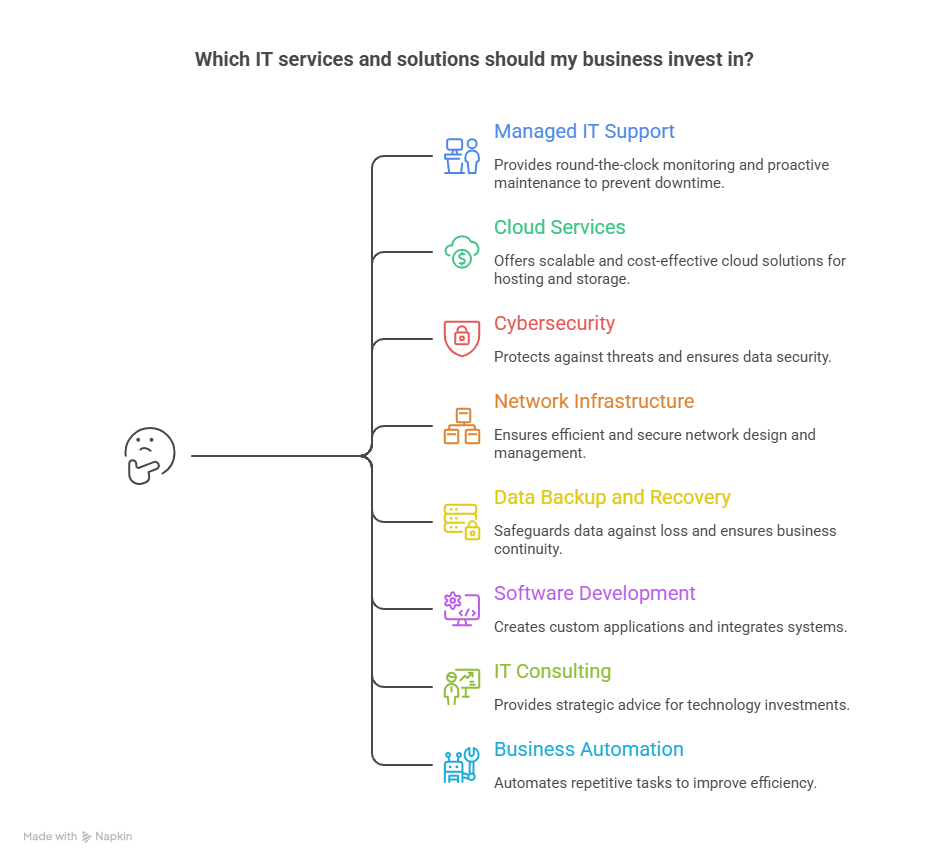
Not every business needs everything. But you should know the full menu before you order. Here are the main categories that make up modern IT services and solutions.
Managed IT Support
This is the backbone. Round-the-clock monitoring, help desk access, device management, and proactive maintenance. Instead of calling someone after a server crashes, a managed provider catches the warning signs first. Honestly, most businesses underestimate how much downtime costs them until they add up a single bad week.
Cloud Services
Migration, hosting, storage, and cloud-native application management. Moving to the cloud isn’t about being trendy — it’s about paying only for what you use and scaling without buying hardware. AWS, Microsoft Azure, and Google Cloud dominate here, and a solid provider helps you pick and configure the right mix.
Cybersecurity
Firewalls, endpoint protection, threat detection, employee training, and incident response. This category has exploded in importance. More on why below, because it deserves its own section.
Network Infrastructure
Design, setup, and management of your wired and wireless networks. A poorly designed network slows everything down and creates security holes. Get this right early and you save yourself years of grief.
Data Backup and Disaster Recovery
The unglamorous stuff that saves companies. When ransomware hits or a drive fails, clean backups and a tested recovery plan are the difference between a bad afternoon and a closed business.
Software Development and Integration
Custom applications, API integrations, and connecting systems that weren’t built to talk to each other. This is where IT solutions for business get tailored to how you actually operate.
IT Consulting and Strategy
The advisory layer. Where should you invest? What’s the roadmap? Which legacy systems are quietly bleeding you dry? A good consultant answers those before you spend a rupee. Too many businesses buy technology reactively — a competitor adopts something, so they rush to match it. That’s backwards. Strategy comes first, tools second. The right advisor maps your business goals to a technology plan, then sequences the spending so you get results in the order that matters most.
Business Automation and Workflow Tools
The newest layer, and arguably the fastest-growing. Automating repetitive tasks — invoicing, onboarding, data entry, reporting — removes human error and frees hours every week. Pair automation with AI-driven tools and the returns climb sharply. This is where modern IT services solutions separate themselves from the old break-fix model. A provider who only fixes broken laptops is stuck in the past. The ones worth hiring help you run leaner, not just run.
Why IT Solutions for Business Drive Growth
Let’s be honest — nobody buys technology for its own sake. You buy it because it moves the business forward. So where does the growth actually come from?
Speed. When your systems work, your people work. A sales team that isn’t waiting on a frozen CRM closes more deals. A support team with clean data resolves tickets faster. These small gains compound.
Focus. Every hour your team spends fighting a printer or resetting passwords is an hour not spent on the work that pays the bills. Outsourcing that friction to a provider frees your best people for their best work.
Scale. Growth breaks things. What worked at 10 employees collapses at 50. The right IT solutions for business are built to grow with you — add users, add locations, add capacity, without rebuilding from scratch.
Trust. Customers care about security now. A single breach can wipe out years of reputation. Strong IT quietly protects the trust you’ve earned, which is worth more than most balance sheets show.
Consider the numbers. Research cited by IBM in its annual data breach studies consistently puts the average cost of a data breach in the millions — a figure that would sink most small businesses outright. Prevention is cheaper than recovery every single time. That’s not a sales pitch; it’s arithmetic.
Which brings us to a point worth sitting with: it solutions services aren’t a cost center. They’re a growth investment that happens to reduce risk on the side.
There’s a compounding effect people miss. A business with reliable technology makes faster decisions, ships work sooner, and recovers from setbacks quicker than a competitor limping along on aging systems. Over a year, those small advantages stack into a genuine gap. Two similar companies — same market, same product — can end up in completely different places purely because one treated technology as strategic and the other treated it as an afterthought. The way I’ve seen it play out, the winners rarely have the flashiest tools. They have the ones that quietly work, every day, without drama.
Managed Services vs In-House IT: A Comparison
One of the biggest decisions you’ll face is whether to build an internal team or partner with a managed provider. There’s no universally right answer — but there’s a right answer for your situation. Here’s how they stack up.
| Factor | In-House IT Team | Managed IT Services |
| Upfront cost | High — salaries, benefits, training, tools | Low — predictable monthly fee |
| Availability | Business hours, limited coverage | 24/7 monitoring and support |
| Expertise range | Limited to your hires’ skills | Access to broad specialist teams |
| Scalability | Slow — requires new hires | Fast — adjust your plan |
| Response to threats | Reactive, often stretched thin | Proactive, dedicated monitoring |
| Best for | Large enterprises with complex needs | SMBs and growing mid-market firms |
For most small and mid-sized businesses, managed IT services and solutions win on cost and coverage. You get a full team’s expertise for less than one senior hire. Larger enterprises with unique, high-security requirements often blend both — an internal team for strategy, a provider for scale.
The way I look at it, the question isn’t “which is better?” It’s “what does my business actually need this year, and next?”
Cybersecurity as a Growth Enabler, Not Just Insurance
Most people file cybersecurity under “necessary evil.” That’s a mistake. Done right, it opens doors.
Think about it. Enterprise clients won’t sign with a vendor who can’t prove their data is safe. Compliance certifications — SOC 2, ISO 27001, GDPR readiness — are increasingly the price of entry for bigger contracts. Strong security isn’t just defense; it’s a sales asset.
The threat landscape keeps shifting. Ransomware, phishing, supply-chain attacks, and now AI-powered social engineering. NirakTech has covered the rise of dark web credential trading and voice-imposter scams precisely because these threats hit small businesses hardest — they’re seen as soft targets. A good security stack for IT solutions for business includes:
- Endpoint detection and response across every device
- Multi-factor authentication on everything that matters
- Regular employee awareness training (people are the weakest link)
- Continuous vulnerability scanning and patching
- A tested incident response plan — not a document nobody’s read
Here’s what’s often overlooked: security training. You can spend a fortune on tools, but one employee clicking a bad link undoes all of it. The best IT services solutions treat your team as part of the defense, not a liability to work around.
Worth noting: the U.S. Cybersecurity and Infrastructure Security Agency (CISA) publishes free guidance that any business can use as a starting baseline. Even small firms should read it.
Cloud Migration and Infrastructure Modernization
Legacy systems are quiet killers. They run, technically. But they slow you down, cost more to maintain than you’d guess, and create security gaps that never get patched. Modernizing infrastructure is one of the highest-return it solutions and services a growing business can invest in.
Cloud migration isn’t a single flip of a switch. It’s a process — and rushing it causes more problems than it solves. A sound migration looks like this:
- Assessment. What do you run now? What depends on what? What’s safe to move first?
- Planning. Pick your cloud model — public, private, or hybrid — based on cost, compliance, and control needs.
- Migration. Move in phases. Non-critical systems first, validate, then move the important stuff.
- Optimization. Once you’re up, tune for cost. Cloud bills balloon when nobody’s watching.
The payoff? You stop buying and babysitting hardware. You scale capacity on demand. And your team can work from anywhere, which — post-2020 — is no longer optional for most companies.
That said, the cloud isn’t automatically cheaper. Poorly managed cloud spend can exceed old server costs. This is exactly where experienced IT services solutions earn their keep — they right-size your setup so you pay for what you use and nothing more.
How to Choose the Right IT Services Solutions Partner
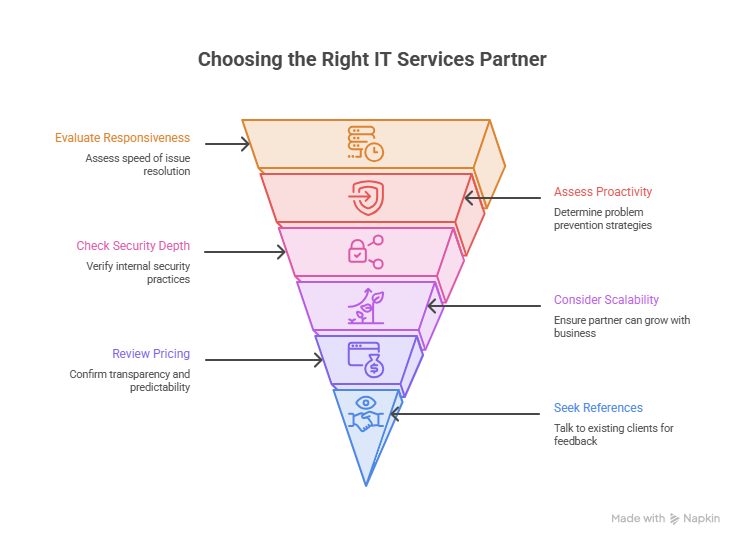
You’ve decided to bring in help. Good. Now the hard part — picking the right partner. Get this wrong and you’ll spend more time managing the vendor than you saved. Here’s what actually matters.
Responsiveness. How fast do they reply when something breaks? Ask for their guaranteed response times in writing. A slow provider is worse than no provider during an outage.
Proactive vs reactive. The best providers prevent problems. The worst just show up after. Ask how they monitor and what they do before you notice an issue.
Security depth. Do they practice what they preach? A provider with weak internal security is a risk to you. Ask about their own certifications.
Scalability. Can they grow with you? A partner perfect for 10 employees may buckle at 100. Think a year ahead.
Clear pricing. Surprise invoices destroy trust. Good IT solutions services come with transparent, predictable costs. If the pricing needs a decoder ring, walk.
Real references. Talk to their existing clients. Not the two hand-picked testimonials — ask for a client in your industry and size.
One more, and it’s underrated: cultural fit. You’ll talk to these people constantly. If communication feels like pulling teeth during the sales process, it won’t improve later.
Pricing Models Compared
Money talks, so let’s get concrete. Providers structure IT services and solutions pricing in a few common ways. Knowing them helps you compare apples to apples.
| Pricing Model | How It Works | Best For | Watch Out For |
| Per-device | Flat fee per device managed | Businesses with predictable device counts | Costs climbing as you add hardware |
| Per-user | Flat fee per employee, all their devices | Teams with multiple devices per person | Paying for inactive accounts |
| Tiered packages | Bronze/silver/gold service levels | Companies wanting clear feature sets | Being upsold to a tier you don’t need |
| All-inclusive | One flat fee covers everything | Firms wanting total predictability | Higher base cost, possible over-buying |
| A la carte | Pay only for specific services | Businesses with narrow, defined needs | Gaps in coverage, nickel-and-diming |
For most growing companies, per-user or tiered models offer the cleanest balance of predictability and value. All-inclusive works beautifully when you want zero surprises and don’t mind paying a premium for peace of mind.
The cheapest option rarely wins long-term. What you want is the model that matches how your business actually uses technology — and a provider honest enough to recommend the right fit rather than the most expensive one.
Common Mistakes Businesses Make
After all this, let me flag the traps I see most often. Avoid these and you’re ahead of most.
Buying tools without support. A solution nobody maintains becomes a liability. Always pair solutions with services.
Ignoring backups until it’s too late. Everyone assumes their data is safe. Then a drive dies, and it isn’t. Test your recovery, don’t just assume it works.
Treating security as one-and-done. Threats evolve weekly. A firewall you set up two years ago and forgot about is not protecting you today.
Over-buying. More isn’t better. Plenty of businesses pay for enterprise features they’ll never touch. Match spend to actual need.
Choosing on price alone. The cheapest provider often costs the most once you factor in downtime and mistakes. Value beats price.
No exit plan. What happens if you leave your provider? If they hold your systems hostage, you’re stuck. Make sure ownership and access are yours from day one.
Getting it solutions and services right isn’t about spending the most. It’s about spending smart — matching the right services to real business needs, with a partner who’s genuinely invested in your growth.
The Bottom Line
Technology should push your business forward, not hold it back. The right IT solutions and services do exactly that — keeping systems running, data protected, and your team focused on what actually grows revenue. Whether you need managed support, a cloud move, or a serious security upgrade, the goal is the same: turn technology into an advantage instead of a liability. NirakTech breaks down these topics so business owners can make informed decisions without the jargon. Ready to make your IT services and solutions work harder for your growth? Start with an honest assessment of where you stand today — and build from there.
Frequently Asked Questions
What is the difference between IT services and IT solutions?
IT services are ongoing activities that keep your technology running — support, monitoring, maintenance, backups. IT solutions are packaged fixes to specific problems, like a cloud migration or a new security system. Together they form complete it services and solutions for a business. You generally need both.
How much do IT solutions and services cost for a small business?
It varies widely based on your size, needs, and pricing model. Per-user managed plans are common for small businesses, offering predictable monthly costs. The key is matching the plan to your actual usage rather than over-buying features you won’t use.
Are IT solutions for business worth it for very small companies?
Yes — often more so. Small teams can’t afford downtime or a full internal IT department. Managed IT solutions for business give small companies enterprise-grade support and security at a fraction of the cost of hiring, which levels the playing field against bigger competitors.
How do I know if my current IT services solutions are working?
Look at downtime, response times, and whether problems get prevented or just patched after the fact. If you’re constantly firefighting, waiting on slow responses, or unsure when your last backup test was, your current setup is underperforming.
What should I prioritize first when investing in IT?
Start with security and backups — they protect what you’ve already built. Then modernize infrastructure and add proactive monitoring. A good provider assesses your situation and sequences the roadmap so you’re not spending on the wrong things at the wrong time.
Can IT services and solutions help my business grow, or just prevent problems?
Both. Beyond preventing costly downtime and breaches, the right it services solutions speed up your team, free your people for high-value work, and let you scale smoothly. Strong security also opens doors to enterprise clients who require it.
How long does a cloud migration take?
\It depends on your systems’ complexity, but a phased migration typically runs from a few weeks to several months. Rushing it causes problems — a proper migration assesses dependencies first, moves non-critical systems to validate, then handles the important workloads.