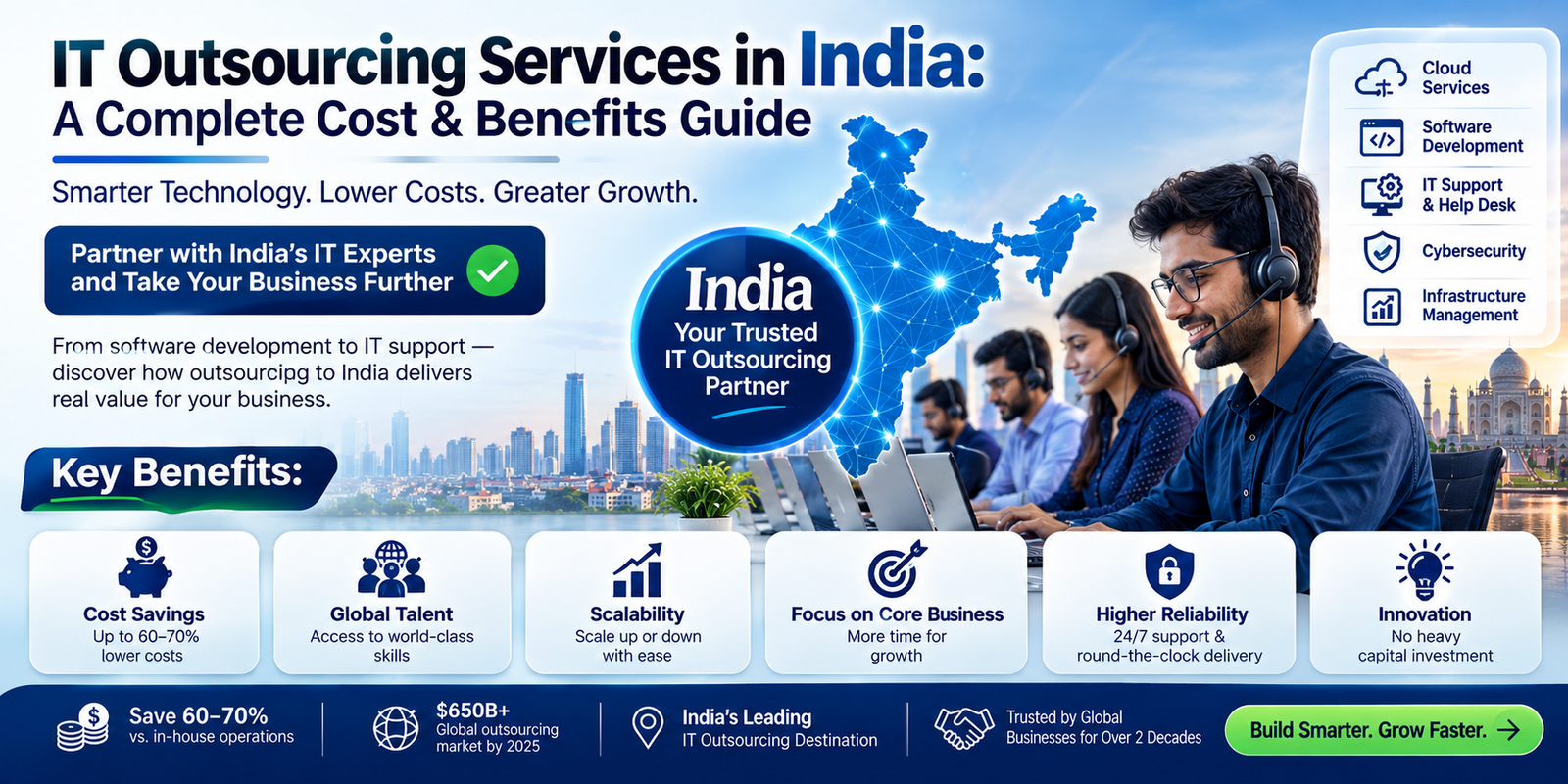
Finding skilled tech talent is getting harder, and running an in-house IT department is getting more expensive. That’s the squeeze most growing businesses feel right now. IT outsourcing services offer a way out — you hand specific technology work to an external partner, keep your costs predictable, and free your own team to focus on what actually moves the business. India sits at the center of this shift. This guide walks through what IT outsourcing services really cost, the benefits of outsourcing IT services worth paying for, and how to pick the right partner without getting burned.
Let’s be honest — the numbers are hard to ignore. The global IT outsourcing market is projected to cross $650 billion in 2025, and India remains the single largest destination for it. So if you’re weighing whether to outsource IT support or build everything internally, you’re asking the right question at the right time.
What Are IT Outsourcing Services?
IT outsourcing services means hiring an external provider to handle specific technology tasks or projects instead of managing them in-house. Think software development, system maintenance, cybersecurity, cloud management, or day-to-day technical support. Instead of recruiting, training, and retaining a full internal team, you delegate the work to specialists who do it every day.
Here’s a simple example. A retail company in the US hires an IT outsourcing company India to build and maintain its e-commerce platform. The retailer focuses on merchandising and sales; the provider handles the code, the servers, and the uptime. That division of labor is the whole idea behind IT outsourcing services — let experts run the technology so you can run the business.
The model works because IT is rarely anyone’s core competency outside of tech firms. Why staff a 24/7 help desk yourself when an outsourced IT provider already runs one? Why hire three cloud engineers when you only need their full skill set a few weeks a year? These are the questions that push companies toward IT outsourcing services in the first place.
Why India Dominates IT Outsourcing
India has been the world’s back office for IT for over two decades, and the lead hasn’t slipped. A few reasons stand out. The country produces roughly 1.5 million engineering graduates a year, giving providers a deep, English-fluent talent pool. Labor rates run a fraction of North American or Western European costs. And the time-zone gap, once seen as a drawback, now doubles as an advantage — your Indian team works while your local office sleeps, so tickets get resolved overnight.
When you outsource IT support to India, you’re tapping an ecosystem, not just cheaper labor. Cities like Bangalore, Hyderabad, Pune, and the Delhi-NCR belt (where NirakTech operates) have mature infrastructure, established data-security practices, and a workforce that has delivered for Fortune 500 clients for years. That maturity matters. It’s the difference between a provider who disappears after go-live and one who becomes a genuine extension of your team.
There’s a reason the benefits of IT outsourcing keep drawing companies back here. The cost-to-quality ratio is hard to beat anywhere else on the map.
Popular Types of IT Outsourcing Services
IT outsourcing isn’t one thing. Depending on what your business needs, you can hand off a narrow slice of work or your entire technology function. Here are the categories most companies delegate.
Software development covers building, testing, and maintaining applications — from mobile apps to enterprise platforms — without carrying a full in-house dev team.
IT support and help desk handles troubleshooting, ticket resolution, and end-user assistance. This is where most companies first decide to outsource IT support, because the volume is steady and the work is well-defined.
Infrastructure management keeps servers, networks, devices, and data centers secure and running. It’s unglamorous and absolutely critical.
Cloud services cover migration, storage, virtual servers, and SaaS management — the backbone of modern scalability.
Cybersecurity protects your systems and data through threat monitoring, vulnerability assessments, and rapid incident response. With breach costs climbing every year, this is one area no business should leave to chance.
Data management and analytics turns raw information into decisions — storage, processing, and the reporting layer on top.
Application management keeps your critical software updated, patched, and aligned with how your business actually evolves.
DevOps services automate the pipeline between development and operations, cutting release times and lifting quality.
A good IT outsourcing company India will offer most of these under one roof, which is exactly why bundling with a single outsourced IT provider often beats stitching together five separate vendors.
The Real Benefits of Outsourcing IT Services
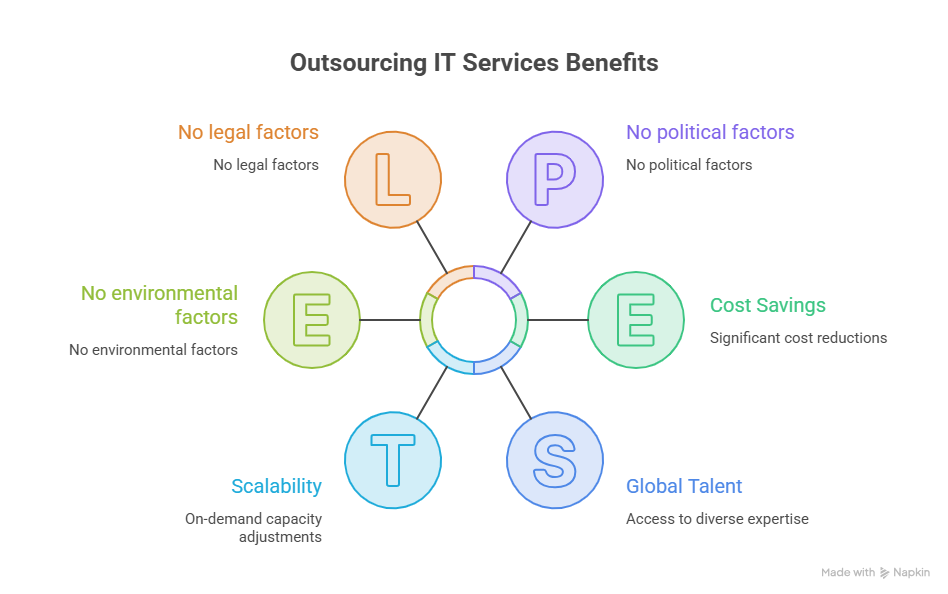
This is the part that decides most budgets. The benefits of outsourcing IT services are real, but they’re worth understanding beyond the sales pitch.
Cost Savings That Actually Show Up
The headline benefit is money. Companies can save up to 60–70% compared to running the same functions in-house, once you factor in salaries, benefits, office space, tools, and training. When you outsource IT support to India specifically, the base rate advantage is steep — but the savings compound because you’re not carrying fixed overhead for capacity you only occasionally use.
Access to Global Talent
Outsourcing opens a talent pool you’d never reach locally. Need a Kubernetes specialist for six weeks? A provider has one on the bench. That flexibility is one of the quieter but more powerful benefits of IT outsourcing — you rent expertise instead of hiring it permanently.
Focus on Your Core Business
Every hour your leadership spends managing IT is an hour not spent on customers, product, or growth. Handing technology to an outsourced IT provider lets your team concentrate on what you’re actually in business to do. This is the benefit clients tell us they underestimate the most.
Scalability On Demand
Business isn’t flat. You scale up for a product launch, scale down after. IT outsourcing services let you flex capacity without the pain of hiring and firing. Try doing that with a permanent staff.
Round-the-Clock Coverage
With teams across time zones, your systems get watched 24/7. A server hiccup at 3 a.m. your time is midday for your Indian team. That’s continuous coverage most in-house departments simply can’t match without expensive night shifts.
Faster Time to Market
Experienced providers have processes and people ready to go. That means projects ship faster — you’re not spending three months recruiting before work even begins.
The Risks You Should Plan For
No honest guide skips the downsides. IT outsourcing services carry real risks, and the difference between success and frustration usually comes down to how well you plan for them.
Communication gaps happen. Time zones, language, and work-culture differences can muddy requirements if you don’t set clear channels early. The fix is process, not luck — regular check-ins and shared tools close most of the gap.
Quality control gets harder with remote teams. Set measurable standards and hold vendors to SLAs from day one.
Security and privacy risks rise whenever you share data externally. Vet your provider’s certifications, insist on strong contracts, and audit regularly.
Hidden costs can creep in through rework, travel, or scope creep. Read the contract carefully and define requirements tightly.
Over-dependence on a single vendor is a genuine trap. Keep some in-house knowledge so you’re never fully hostage to one relationship.
None of these are dealbreakers. They’re just reasons to choose your outsourced IT provider carefully rather than by price alone.
IT Outsourcing Cost: What You’ll Actually Pay in 2025
Now the question everyone actually opened this guide for. IT outsourcing cost varies widely based on the technology, the provider’s expertise, project complexity, and — above all — geography. Let’s break it down honestly.
Hourly Rates by Region
Where your provider sits changes the number dramatically. India and South Asia consistently offer the strongest cost-to-quality balance.
| Region | Hourly Rate (USD) |
| North America | $100 – $200 |
| Western Europe | $80 – $150 |
| Eastern Europe | $30 – $70 |
| India / South Asia | $20 – $50 |
| Southeast Asia | $15 – $40 |
| Latin America | $25 – $60 |
That India column is why so many companies choose an IT outsourcing company India over a domestic vendor. You’re often paying a quarter of the North American rate for comparable engineering quality.
Project-Based Pricing
For fixed-scope work, IT outsourcing cost usually depends on project size and complexity. Here’s a rough map.
| Project Size | Typical Timeline | Basic Web Development | Custom Software | Mobile App |
| Small | Weeks to 2 months | $5,000 – $10,000 | $10,000 – $20,000 | $15,000 – $25,000 |
| Medium | 3 – 6 months | $10,000 – $30,000 | $20,000 – $50,000 | $25,000 – $60,000 |
| Large | 6 months – 1 year+ | $30,000 – $60,000 | $50,000 – $150,000 | $60,000 – $120,000 |
Ongoing Maintenance and Managed Support
Development isn’t the end of the bill. Ongoing maintenance typically runs 20–25% of the initial build cost per year. Managed support is usually billed monthly.
| Support Tier | Monthly Fee (USD) |
| Basic Support | $500 – $1,000 |
| Advanced Support | $1,000 – $2,500 |
| Full Managed Service | $2,500 – $5,000 |
In-House vs Outsourced: The Honest Comparison
People forget that an in-house hire costs roughly twice their base salary once you add benefits, office space, and equipment. Outsourcing adds about 20% for coordination — but skips almost all the fixed overhead. Here’s how it stacks up.
| Cost Component | In-House (USD) | Outsourced (USD) |
| Salary (annual) | $80,000 – $120,000 | Bundled in provider rate |
| Benefits (annual) | $20,000 – $30,000 | None |
| Office space (annual) | $10,000 – $20,000 | None |
| Training | $5,000 – $10,000 | $2,000 – $5,000 |
| Tools & equipment | $5,000 – $15,000 | Included |
| Provider fees | N/A | $30,000 – $150,000 |
The math is usually decisive. For most small and mid-sized businesses, IT outsourcing services come out cheaper even before you count the savings on management overhead.
What Drives Your Final Number
A few factors push the IT outsourcing cost up or down. Project complexity demands specialized skills. A niche technology stack is pricier because expertise is scarce. A vendor’s reputation commands a premium — usually worth it. Longer engagements may earn volume discounts. And overlapping time zones for real-time work can add to the bill. Knowing these levers helps you negotiate a fair price with any outsourced IT provider.
How to Choose the Right IT Outsourcing Company in India
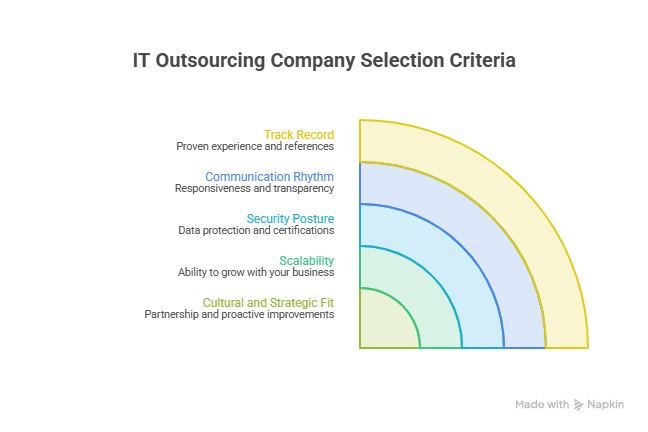
Picking a partner is where most outsourcing relationships are won or lost. A cheap vendor who ghosts you after launch costs far more than a slightly pricier one who sticks around. Here’s what to weigh.
Track record over price. Ask for references and case studies. A provider who’s delivered for clients in your industry already understands your headaches.
Communication rhythm. Test responsiveness before you sign. If they’re slow during sales, they’ll be slower once you’re locked in.
Security posture. Check certifications, data-handling practices, and contract terms. Non-negotiable.
Cultural and strategic fit. The best outsourced IT providers act like partners, not order-takers. You want someone who flags problems and suggests improvements, not just someone who closes tickets.
Scalability. Can they grow with you? A partner who can staff up as you expand saves you a painful vendor switch later.
At NirakTech, we’ve built our IT outsourcing services around exactly these principles — reliable managed services, cloud and cybersecurity expertise, and a partnership approach that treats your systems as if they were our own. That’s the standard any IT outsourcing company India should hold itself to.
Engagement Models: How You Actually Work With a Provider
Before you sign anything, it helps to understand the shapes IT outsourcing services can take. The way you structure the engagement shapes cost, control, and how much day-to-day management lands on your plate.
Project-based (fixed scope). You define the deliverable, agree a price, and the provider delivers it. Best for one-off builds — a website, an app, a migration — where requirements are clear. Low management overhead, but limited flexibility if the scope shifts mid-way.
Dedicated team. The provider assigns engineers who work only on your account, effectively becoming a remote extension of your staff. This is the model most companies grow into once they trust their IT outsourcing company India. You direct the work; they supply the people, the desks, and the HR headaches.
Staff augmentation. You plug individual specialists into your existing team to fill a skill gap fast. Need a security engineer for a three-month audit? This is how you outsource IT support for a specific need without a long commitment.
Managed services. The provider takes full ownership of a function — your help desk, your cloud, your security operations — and runs it against agreed SLAs. This is where an outsourced IT provider delivers the most hands-off value, and it’s the backbone of what NirakTech does for its clients.
Most businesses blend these over time. You might start with a project, like the team, and shift to a dedicated or managed arrangement. That evolution is normal, and a good provider makes it easy.
| Model | Best For | Your Control | Management Effort |
| Project-based | Defined one-off builds | Low mid-project | Low |
| Dedicated team | Ongoing product work | High | Medium |
| Staff augmentation | Filling skill gaps fast | High | Medium-high |
| Managed services | Running whole functions | Via SLAs | Very low |
A Simple Roadmap to Get Started
If you’ve decided the benefits of outsourcing IT services are worth pursuing, here’s a practical sequence that keeps the process calm instead of chaotic.
First, define what you’re actually outsourcing. Be specific. “Our IT” is too vague; “24/7 help desk plus cloud infrastructure management” is a brief a provider can quote against. Clear scope is the single biggest predictor of a smooth engagement.
Second, shortlist three or four providers and compare more than price. Look at case studies, ask for client references, and notice how they communicate during the sales conversation — that pattern rarely changes later.
Third, run a small paid pilot before the big commitment. A contained first project tells you more about an outsourced IT provider and the quality of their delivery than any pitch deck. You see the real quality, the real responsiveness, the real fit.
Fourth, formalize the relationship with a contract that spells out SLAs, security obligations, IP ownership, and an exit clause. Boring paperwork, yes — but it’s what protects both sides when things get busy.
Finally, invest in the onboarding. Share context, introduce your tools, set the communication rhythm. The companies that get the most from IT outsourcing services treat the first month as a partnership build, not a handoff. Get that right and the rest tends to take care of itself.
Key IT Outsourcing Trends to Watch
The industry isn’t standing still. A few shifts are worth knowing before you commit.
Offshore is winning. Offshore models led the market with a 43% share in 2024 and are projected to reach roughly 45% by 2028 — a clear vote of confidence in providers based in India and similar hubs.
AI is reshaping delivery. Generative AI can automate work that eats 60–70% of staff time in some functions, according to McKinsey. Smart providers are folding AI into help desks, testing, and support to deliver faster and cheaper.
Cybersecurity spending is surging. With breach costs at record highs, security has moved from an add-on to a headline reason companies outsource IT support at all.
Specialized skills are in demand. Blockchain, machine learning, and niche cloud expertise are increasingly outsourced because building them in-house is slow and costly.
These trends all point the same direction — toward experienced, specialized partners who can move quickly. That’s the value proposition behind modern IT outsourcing services.
Which Industries Benefit Most
Almost any business that runs on technology can gain from handing IT to specialists, but a few sectors see outsized returns. Understanding where the model shines helps you gauge whether it fits your own situation.
Banking, financial services, and insurance lead the way. These firms handle huge transaction volumes and strict compliance demands, so they lean heavily on IT outsourcing services for security, infrastructure, and application work. In fact, the BFSI sector has topped global outsourcing adoption for years, and it generates a large slice of total industry revenue.
Healthcare is close behind. Hospitals, clinics, and health-tech startups outsource everything from patient-portal development to data security, largely because the regulatory burden makes specialized expertise essential. E-commerce and retail rely on external teams to keep storefronts fast, secure, and always online — downtime there translates directly into lost sales.
Startups and SMEs may benefit the most of all, proportionally. A young company rarely has the budget to hire a full engineering department, so partnering with a provider gives it enterprise-grade capability at a fraction of the fixed cost. Manufacturing, logistics, education, and professional-services firms round out the list, each delegating the technology work that isn’t central to their trade.
The common thread is simple. If technology is essential to your operation but not the thing you sell, delegating it to experts almost always frees resources and sharpens focus. That’s the quiet logic driving adoption across every one of these sectors, and it’s why the market keeps expanding year after year.
Common Mistakes to Avoid
A quick list of the errors that sink outsourcing relationships. Skip these and you’re most of the way to success.
| Mistake | The Fix |
| Choosing on price alone | Weigh quality, references, and fit — not just the hourly rate |
| Vague requirements | Define clear, measurable goals before work starts |
| Weak contracts | Spell out SLAs, security, IP rights, and exit terms |
| Poor communication cadence | Set regular check-ins and shared tools from day one |
| Ignoring security | Insist on certifications and regular audits |
| No exit strategy | Plan for data transfer and continuity before you ever need it |
Every one of these is avoidable with a little upfront discipline. The companies that get the most from the benefits of outsourcing IT services are simply the ones that plan before they leap.
Final Word
The case for IT outsourcing services has only gotten stronger. Talent is scarce, costs are rising, and technology moves faster every quarter — all of which favor handing the work to specialists who do it full-time. India remains the smartest place to do that, combining cost, quality, and experience like nowhere else. Whether you need to outsource IT support, migrate to the cloud, or lock down your security, the benefits of outsourcing IT services are there for businesses that choose their partner with care. If you’re ready to explore what the right IT outsourcing company India can do for you, NirakTech is here to help you make the move with confidence.
FAQs on IT Outsourcing Services
What are IT outsourcing services?
IT outsourcing services means hiring an external provider to handle technology tasks — software development, support, cloud, cybersecurity, and more — instead of managing them with an internal team. It cuts costs and gives you access to specialized expertise on demand.
Why choose an IT outsourcing company India over a local vendor?
An IT outsourcing company India typically offers the best cost-to-quality ratio in the world, backed by a deep English-speaking talent pool and two decades of delivery experience for global clients. You often pay a fraction of North American rates for comparable quality.
How much does it cost to outsource IT support?
IT outsourcing cost depends on scope and region. In India, hourly rates run roughly $20–$50, small projects start around $5,000, and managed support tiers range from $500 to $5,000 per month. Outsourcing is usually cheaper than in-house once overhead is counted.
What are the main benefits of IT outsourcing?
The core benefits of IT outsourcing are cost savings, access to global talent, scalability, round-the-clock coverage, faster time to market, and the freedom to focus on your core business.
Is it safe to outsource IT support overseas?
Yes, when you vet properly. Choose an outsourced IT provider with strong security certifications, clear contracts, and audit practices. The risk isn’t the model — it’s picking the wrong partner.
What should I look for in outsourced IT providers?
Prioritize track record, communication, security posture, cultural fit, and scalability. The best outsourced IT providers behave like strategic partners invested in your success, not vendors closing tickets.