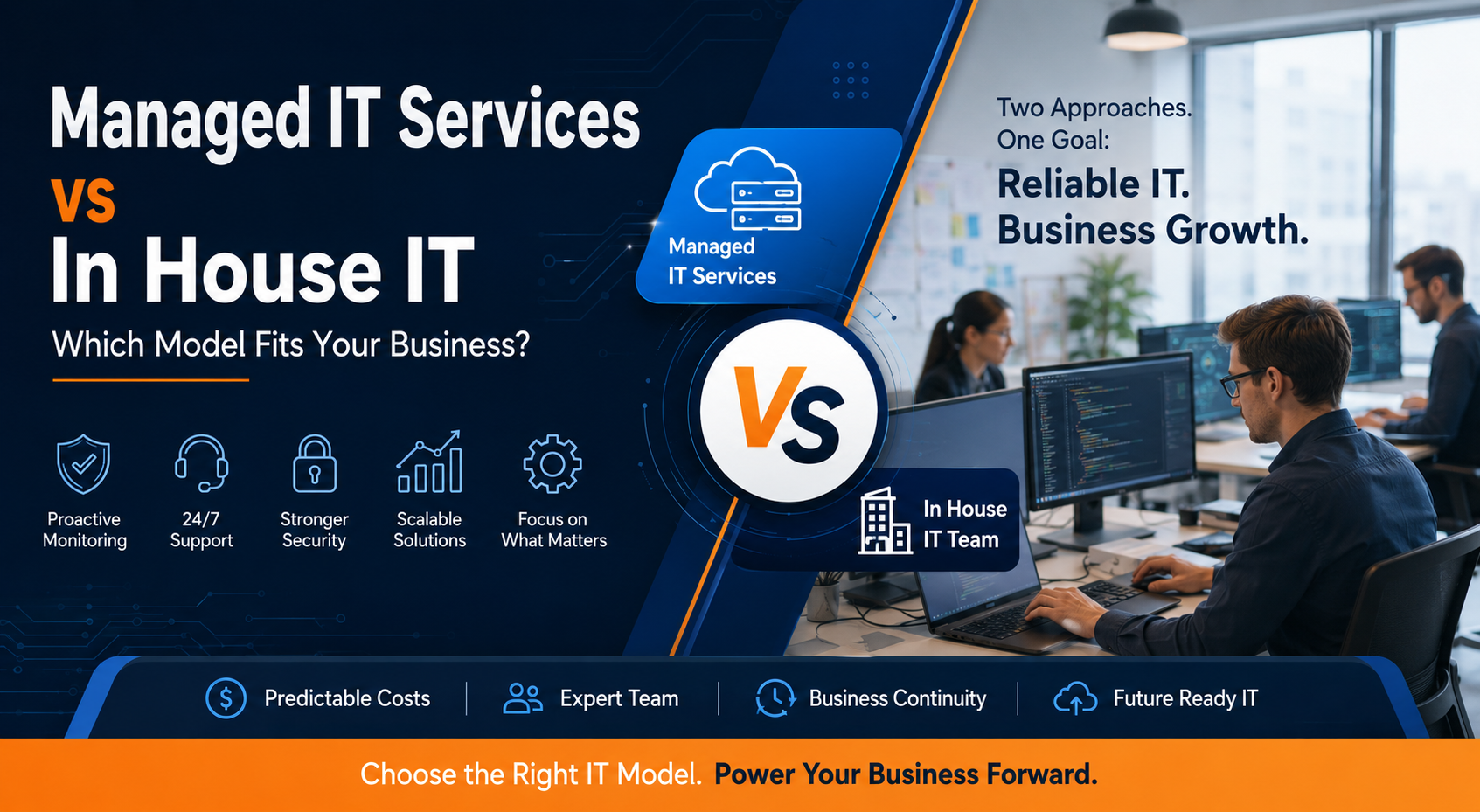
Most businesses hit a wall at some point. Systems grow, security risks pile up, and the small team keeping everything running starts to buckle under the weight. That’s usually when the debate over managed it services vs in house IT lands on the table. And it’s rarely as simple as “which one is cheaper.”
Here’s the thing. This isn’t only a budget call. It’s a decision about coverage, depth, and what actually happens when a server dies at 11pm on a Saturday. Some companies want predictable support and a broad bench of skills without building a full department. Others want tight control and people who know every quirk of their internal systems by heart. Both instincts are valid. The right answer depends on where your business is right now — and where it’s headed.
At Niraktech, we’ve watched growing companies wrestle with this exact question. So let’s break it down properly, weigh outsourced IT support against keeping everything internal, and figure out which path makes sense for you.
What Managed IT Services Actually Mean
Let’s start with definitions, because the term gets thrown around loosely. Managed it services means handing off your day-to-day technology operations to a specialized provider — a managed service provider, or MSP. Instead of your own staff chasing every ticket, the provider takes ownership of monitoring, maintenance, patching, security updates, and infrastructure health on an ongoing basis.
The shift is bigger than it sounds. It moves IT from a reactive cost center into a proactive function. A good managed service provider msp watches your systems around the clock, catches problems early, and applies fixes before your users even notice something’s off. That’s a very different rhythm from waiting for someone to complain that email is down.
A typical managed IT engagement covers a familiar spread: help desk support, patch management, backup and recovery planning, network oversight, and baseline cybersecurity hygiene. The more advanced providers layer on workflow automation and centralized service portals that give both sides clearer visibility. Worth noting: the best managed IT engagements feel less like vendor transactions and more like an extension of your own team.
And yes, outsource it support services is essentially the same idea described from a different angle — you’re outsourcing the operational load so your internal people can breathe.
What In House IT Teams Typically Handle
Now the other side. In house services rely on employees who work exclusively for one organization. They handle daily user support, hardware troubleshooting, and longer projects like system upgrades or custom integrations. They sit down the hall. They know the culture, the applications, and the sensitive data flows.
That proximity is the real strength of in house services. Leadership gets direct oversight of priorities and immediate access to people who already understand the environment. Someone can walk over, look at a broken machine, and fix it on the spot. For businesses running highly specialized or constantly evolving internal applications, that institutional knowledge is genuinely hard to replicate.
But there’s a ceiling. Coverage usually stops at standard business hours. Knowledge gaps open up the moment a key person takes leave or the workload spans multiple technical domains — cloud architecture, compliance frameworks, advanced threat detection. Recruiting and keeping specialists across all of those areas gets expensive fast. A single hire, however talented, can’t monitor systems overnight, stay current on every security domain, and run the help desk while also planning next year’s infrastructure. That’s three or four jobs stitched into one.
This is exactly where the managed it services conversation usually starts. When in house services hit their limit, businesses look outward.
Managed IT Services vs In House IT: A Side-by-Side Comparison
Sometimes a direct comparison clears the fog faster than paragraphs. Here’s how the two models stack up across the factors that matter most.
| Factor | Managed IT Services (MSP) | In House IT Team |
| Cost structure | Predictable recurring fee based on scope | Fixed salaries plus benefits, tools, training, recruitment |
| Coverage | Continuous monitoring with defined SLAs | Usually business hours, gaps during absences |
| Expertise breadth | Full team with varied specializations | Limited to skills of current employees |
| Scalability | Adjust up or down with relative ease | Requires hiring, onboarding, restructuring |
| Focus | Prevention and early detection | Often shifts toward reactive ticket handling |
| Control | Shared through SLAs and reporting | Full internal authority and oversight |
| Security posture | Dedicated tools and security resources | Depends on internal depth and training |
| Institutional knowledge | Built over time through onboarding | Deep and immediate |
Look at that table honestly and you’ll notice something. Neither column wins outright. Managed it services dominate on coverage, scalability, and breadth. In house services win on control and institutional depth. The trick is knowing which of those columns matches your actual pressures.
Why So Many Businesses Lean Toward Managed IT Services
Let’s be honest — the momentum has shifted. More companies are choosing outsourced IT support than ever, and the reasons are practical rather than trendy.
First, predictable spending. A managed service provider charges a defined monthly rate for a defined scope. No surprise bills when a system fails or a key employee resigns. For financial planning, that stability is worth a lot more than most leaders admit until they’ve lived through the alternative.
Second, instant access to specialists. Engaging a managed service provider gives you infrastructure experts, cloud specialists, and compliance knowledge from day one — without posting four job openings and waiting months for candidates. A single managed service provider msp effectively rents you a whole department’s worth of skill.
Third, proactive monitoring genuinely reduces outages. When you outsource it support services, someone is watching continuously, so small issues get caught before they cascade. And when something does break, root-cause analysis and permanent fixes tend to land faster than a stretched internal team can manage while juggling ten other priorities.
Fourth — and this one gets overlooked — your own people get their time back. Offloading routine maintenance through the provider frees internal staff to work on projects that actually drive revenue or improve the customer experience. That’s the quiet payoff most businesses underestimate.
There’s a reason the MSP model keeps growing. It solves real, recurring pain without forcing companies to build infrastructure they can’t sustain.
The Trade-Offs of Outsourced IT Support
No model is perfect, and pretending otherwise would be dishonest. Outsourced IT support comes with its own friction points, and you should walk in with eyes open.
Physical presence is the obvious one. A remote managed service provider can’t always show up to swap a failed hard drive, so on-site visits may need separate arrangements. For businesses with heavy hardware needs, that coordination adds steps.
Integration with legacy systems can also get messy. Older, custom-built environments sometimes need extra planning and testing before an external provider slots in cleanly. Communication matters here — the strongest partnerships set clear expectations upfront and keep steady reporting rhythms.
And there’s dependency. When you outsource it support services, you’re trusting an external partner with core operations. A provider with weak processes or thin platform experience can create friction instead of relief. So choose carefully. The best MSP relationships include transparent onboarding, defined success metrics, and a real path for ongoing optimization — not a one-time setup and radio silence.
None of this makes outsourcing a bad choice. It just means the choice of which managed service provider you pick carries real weight.
When Keeping IT In House Makes Strong Sense
Flip the script for a moment. There are legitimate situations where in house services are the smarter play, and any honest comparison has to name them.
Highly regulated industries with strict data residency rules sometimes prefer keeping sensitive operations inside their own walls. When compliance demands tight, documented control over exactly who touches what, internal ownership can feel safer.
Companies with very specific, constantly changing internal applications often find that only dedicated employees build the deep institutional knowledge those systems require over time. A rotating cast of external technicians rarely develops that same intimacy.
And when leadership wants every IT decision to align instantly with shifting business strategy — no external review cycles, no waiting — an in-house services model can respond faster on those judgment calls. Direct authority has its advantages.
Larger enterprises with mature IT functions and the budget for specialized roles sometimes keep strategic architecture internal while using an external provider for monitoring, after-hours support, or specific projects. Which brings us neatly to the option most people forget exists.
The Hybrid Model: Why Choose When You Can Blend?
Here’s something the “either/or” framing misses entirely. You don’t have to pick one side of the managed IT vs in house debate. Plenty of businesses run both.
The hybrid model — sometimes called co-managed IT — keeps a small internal contact who handles daily user requests and knows the environment intimately, while a managed service provider covers monitoring, security, backup, and strategic planning. You get institutional knowledge and scalable execution capacity. Depth without doubling your headcount.
This blend shows up constantly in real-world setups precisely because it balances control with access to broad expertise. Your internal person keeps quick decision rights over core systems. Your managed service provider msp supplies the after-hours coverage, the specialized tooling, and the surge capacity during growth or complex projects. Clear definitions of who owns what prevent overlap and keep both sides working from the same information.
For a lot of mid-sized companies, honestly? This is the sweet spot. Not fully outsourced IT support, not purely internal — a deliberate mix of both.
Security and Compliance: Where the Models Really Diverge
If there’s one area where the gap between the two models shows up sharply, it’s security. And in 2026, that gap matters more than ever.
An internal team can absolutely run solid security — but only up to the limit of its size and tooling. One or two people can’t realistically watch for threats around the clock, keep every system patched the moment vulnerabilities surface, and stay current across firewalls, endpoints, email filtering, and cloud configuration all at once. Something slips. It usually slips quietly, until it doesn’t.
Managed it services approach security differently because scale is on the provider’s side. With managed it services in place, continuous monitoring runs automatically, not on a periodic manual schedule. Patching happens on a disciplined cadence. Backup verification runs daily rather than whenever someone remembers to check. For regulated industries, structured gap analysis and documented audit trails often come baked into the service, which lightens a genuinely heavy compliance burden.
That said, security responsibility never fully leaves your hands. Even with outsourced IT support in place, your organization still owns data classification, user access policies, and final sign-off on changes that touch regulated systems. Under managed it services, the provider manages infrastructure-level controls and threat monitoring; you keep governance. The strongest partnerships define these boundaries early so nobody assumes the other side has it covered. That clarity, honestly, prevents most of the security surprises businesses fear when they first consider handing off IT.
What to Look for in a Provider
If you do lean toward outsourcing, picking the right partner matters as much as the decision itself. A weak provider undoes every benefit on paper.
Look for transparent onboarding and a clear assessment process before anything gets signed. Ask how response times are defined and what the escalation path looks like when something breaks at 2am. Check whether the managed service provider msp documents its work and reports on performance regularly, or whether you’ll be left guessing. And ask directly about experience with businesses your size and in your industry — a provider fluent in enterprise environments may not be the right fit for a lean mid-market company, and vice versa.
The best engagements feel like a genuine partnership. You want a team that flags risks proactively, suggests improvements, and treats your systems as though they were their own. That’s the difference between outsource it support services that quietly reduce friction and a vendor relationship that adds a layer of it.
Factors That Should Drive Your Decision
So how do you actually choose? A few factors carry more weight than the rest.
Company size and growth trajectory. Smaller and mid-sized businesses often find outsourced IT support more practical because they deliver enterprise-grade capability without enterprise-sized headcount. If you’re scaling fast, the flexibility to add or reduce scope matters enormously.
Industry and compliance requirements. Organizations handling protected health information or financial data need documented controls and audit trails. A mature managed service provider usually already maintains these, which lightens the internal load considerably.
Current IT maturity. Teams already drowning in daily tickets gain the most from shifting routine work to a managed service provider msp. Companies with strong existing processes and a clear two-to-three-year roadmap might prefer to supplement rather than fully replace.
Risk exposure. This is the question most people skip. What happens when systems fail overnight and nobody’s watching? If you have no real after-hours coverage or continuous security monitoring, that gap alone often justifies moving toward a managed service provider or a co-managed arrangement.
Ask yourself plainly: what does your current IT team actually have time for, and what keeps slipping through the cracks? The honest answer usually points you toward the right model.
A Second Comparison: Cost and Capability Over Time
Cost deserves its own closer look, because the headline numbers mislead. Here’s how the two approaches tend to play out across a typical growth curve.
| Consideration | In House Services | Managed IT Services |
| Upfront cost | High — salaries, tools, recruitment | Low — service begins at a set rate |
| Cost predictability | Variable — turnover, emergencies, upgrades | Predictable monthly fee |
| Time to full capability | Months of hiring and onboarding | Available from day one |
| Scaling cost | Steep — each specialist is a new hire | Gradual — adjust scope as needed |
| After-hours coverage | Expensive to staff internally | Included in most managed it services plans |
| Tooling investment | Borne entirely in-house | Shared across provider’s client base |
The pattern is clear enough. In house services carry heavy fixed and upfront costs, while managed it services convert that into a predictable, scalable operating expense. For businesses that value cash-flow stability and fast access to broad skills, that trade tilts toward outsourced IT support. For businesses that need deep, dedicated ownership of unusual systems, internal staffing still earns its keep.
Making the Call for Your Business
There’s no universal winner in the managed it services vs in house question. There’s only the right answer for your size, your risk profile, your budget, and how much technology complexity you’re carrying right now.
If your internal team is stretched thin, if the same IT problems keep resurfacing, or if you have no genuine after-hours or security coverage, those are signals the current model has reached its ceiling. That’s the moment to seriously evaluate a managed service provider — whether that means fully outsourced IT support, a co-managed blend, or a phased transition from where you stand today.
At Niraktech, we help businesses map that gap honestly and build a model that actually fits, rather than forcing everyone into the same template. Sometimes that’s a full managed IT engagement. Sometimes it’s a hybrid. The goal is always the same: reliable systems, predictable costs, and technology that supports your growth instead of fighting it.
The Bottom Line
The choice between managed it services and in-house IT comes down to matching the model to your reality. In house services deliver control and deep familiarity. A managed service provider delivers coverage, breadth, and predictable cost. And a hybrid gives you a measured blend of both. There’s no shame in any of these paths — only in choosing blindly. Weigh your size, your risks, and your roadmap, and the right structure tends to reveal itself. When you’re ready to talk it through, Niraktech is here to help you build IT that works for the business you’re growing into.